
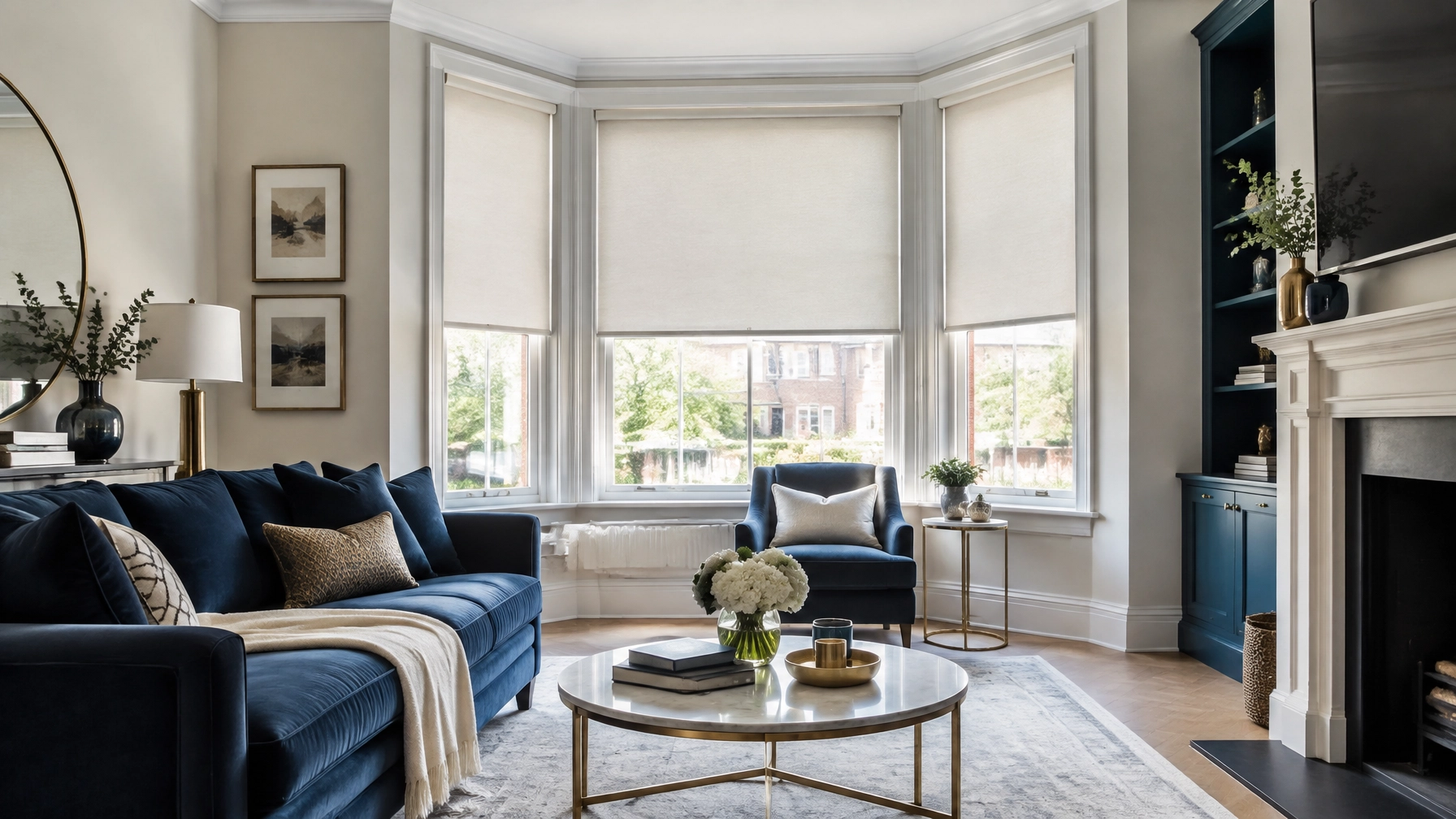
Bay windows bring character, natural light and valuable extra space to a room. They can also create one of the trickiest window-treatment challenges in your home, especially when the panes meet at unusual angles, the recess is shallow, or handles and vents compete for space.
The good news is that an awkward bay does not mean you have to compromise on style or privacy. With accurate measuring, the right blind system and expert installation, you can achieve a clean, coordinated finish that works beautifully through the bright days of autumn and the darker, colder months in Northern Ireland.
At Fiesta Blinds, we believe the key is to treat every bay as an individual project. Our team measures each section carefully, then manufactures bespoke window coverings in-house at our Derry facility for a precise fit, even when the shape is far from standard.
Start with the shape of your bay
Identify the layout first.
A traditional bay may have a wide central window with two angled side windows, while a square bay may use several panes set at near-right angles. Some properties also have bow windows, curved bays or unusual architectural recesses.
Never assume the panes are symmetrical.
Older homes can have small variations in width, height and angle. Even newer properties may have frames that are slightly out of square. Each pane should be measured individually rather than copying one measurement across the entire bay.
Look for anything that projects into the recess.
Window handles, trickle vents, dado rails, deep sills, radiators and tiled reveals can all affect the blind depth or how it operates. These details are especially important when neighbouring blinds need to meet closely at an angle.

Why made-to-measure blinds are the safer choice
They are designed around your actual windows.
Ready-made blinds are produced in standard sizes and may leave excessive gaps, overlap awkwardly or clash at the corners of a bay. Made-to-measure blinds are manufactured to the dimensions and requirements of your individual window sections.
They improve light and privacy control.
A closer fit helps reduce unwanted side gaps, giving you better control over daylight and visibility. This can be particularly valuable in front-facing rooms, overlooked properties and south- or west-facing bays that receive strong afternoon light.
They protect your investment.
A blind that catches on a handle or collides with another blind at the corner can suffer avoidable wear. Accurate planning helps the blind operate smoothly and reduces the risk of damage to the product or surrounding frame.
They give you more design freedom.
You can select different fabrics, colours, openness levels and control options without being restricted to whatever standard sizes happen to be available. Our team can help you balance the look of the whole bay with the practical needs of each individual pane.
How bay-window measuring works
Measuring an angled bay is more involved than measuring a single rectangular window. If you are arranging a professional consultation, the fitter will assess the full recess, the angles and the surrounding room before recommending a product.
If you are taking preliminary measurements yourself, keep the following principles in mind:
Measure every pane separately.
Record the width at the top, middle and bottom, then note the smallest measurement. Do the same for the drop by measuring at the left, centre and right. This helps account for minor variations in the frame.
Allow for the blind hardware.
The cassette, headrail or operating mechanism takes up space. A paper or cardboard template can help show how far the finished blind will project into the room and whether two blinds could meet without touching.
Include handles and vents in your checks.
A blind may fit the glass area but still fail to operate properly if the cassette, fabric or slats collide with a handle. Check the complete operating path, not just the visible width of the pane.
Do not make your own deductions unless instructed.
Different blind systems require different clearances. Your supplier or fitter may apply the necessary deductions during manufacture, so subtracting extra millimetres yourself could leave you with unnecessary light gaps.
Double-check before ordering.
A small error repeated across several sections can become significant. For peace of mind, we recommend a professional measure for angled, bow-shaped or particularly shallow bays.
Choosing the right blind for a bay window
There is no single best blind for every bay. The right choice depends on your priorities, the depth available and the way you use the room.
Roller blinds
A versatile, streamlined option.
Roller blinds work well across separate bay sections because each blind can be made to follow the width of its own pane. They are available in light-filtering, privacy, thermal and blackout fabrics, making them suitable for living rooms, bedrooms and dining areas.
A good choice for coordinated design.
Using the same fabric throughout the bay creates a unified appearance, while different control positions allow each pane to operate independently.
Consider a cassette where appropriate.
A cassette encloses the roller mechanism for a neater finish and can help reduce light leakage around the top of the blind. In a bay, the cassette depth and position must be checked carefully so adjoining units do not clash.

Venetian blinds
Precise control over light and privacy.
Venetian blinds allow you to tilt the slats, so you can soften glare while retaining daylight or close them fully for greater privacy. Aluminium and wood-effect finishes can suit both traditional properties and contemporary extensions.
Check the headrail depth.
The headrail is the critical point when fitting Venetians in an angled bay. Each section needs enough clearance for the headrail and slats to operate without striking the neighbouring blind or the window furniture.
Use them to highlight architectural detail.
Venetians can complement the strong lines of a bay window, particularly when the frames, skirting and other joinery are already prominent features in the room.
Perfect Fit blinds
A neat, frame-mounted solution.
Perfect Fit blinds clip into the glazing bead of compatible uPVC windows and doors, without requiring drilling into the surrounding recess. Because the frame sits close to the window, they can be useful where the bay has limited depth.
Measure the individual glazing areas.
Perfect Fit systems are typically based on the visible glass and glazing-bead dimensions rather than the full bay recess. Compatibility and clearance must be checked on every pane.
Consider the corner details.
Although the bay angle is less central than it is with projecting headrails, neighbouring frames, handles and opening windows still need to be assessed. A professional survey will confirm whether the system is suitable for your specific frames.
Cassette and side-channel options
Cassettes create a cleaner finish.
A cassette houses the roller mechanism and can give the top of the blind a more finished appearance. This is particularly useful in modern interiors where you want the window treatment to look integrated rather than added on.
Side channels can improve coverage.
For suitable roller systems, side channels guide the fabric at the edges and can help reduce side light. They may be useful for bedrooms, media rooms or any space where blackout performance matters.
Clearance is essential.
Side channels and cassettes add depth, so they cannot simply be added without checking the recess. Handles, vents and angled corners must all be considered before the product is manufactured.
Ask for a system-specific recommendation.
A cassette and side-channel combination that works well on a flat window may not be appropriate for every bay. Our team can assess the layout and recommend a configuration that balances appearance, operation and available space.

Common bay-window fitting mistakes to avoid
Choosing one large blind for the whole bay.
A single blind may not follow the angles correctly and can be difficult to operate. Separate blinds are usually more practical, allowing each section to work independently.
Measuring only the glass.
The frame, recess, sill and hardware all affect the final fit. Measuring the visible glass alone can result in a blind that is too wide, too deep or obstructed by the handle.
Ignoring the direction of operation.
Think about whether the blinds will roll towards a wall, door or adjoining blind. Control placement should be agreed before manufacture, particularly where access is limited.
Fitting too close to a radiator or heat source.
Put safety first and consider airflow around radiators and heaters. Your installer can advise on positioning and suitable materials for the room.
Trying to force a standard product into a non-standard space.
Awkward bays reward precision. Avoid unnecessary damage by getting the measurements and fixing method right before drilling or ordering.
Why local in-house manufacturing matters
A bay window is a collection of individual spaces, not one generic opening. When blinds are manufactured in-house in Derry, measurements, fabric choices and finishing details can be managed with greater control from the initial design through to the completed product.
Fiesta has been helping homeowners across Northern Ireland improve their homes since 1970. Our experienced team combines local manufacturing with professional measuring and installation, giving you one point of contact and greater peace of mind throughout the process.
✅ In-house manufacturing at our Derry facility
✅ Made-to-measure blinds for angled and non-standard windows
✅ Professional measuring and installation
✅ Roller, Venetian, Perfect Fit and motorised options
✅ Advice on cassettes, side channels and operating clearance
✅ A tailored, no-obligation quotation
You can explore our full range of Fiesta Blinds or learn more about made-to-measure window treatments.
Get a flawless finish with expert advice
The best bay-window blind is not simply the one that looks attractive in a brochure. It is the product that fits the angles, clears the handles, operates smoothly and gives you the right balance of light, privacy and comfort throughout the year.
We recommend booking a professional measure before making a decision, especially if your bay is angled, unusually shallow or part of an older property. Contact the Fiesta Blinds team for no-obligation advice and tailored guidance for your windows.
Comments are closed